
April 11, 2020
strategy, research, report
This report aims to give an overview of digital brand strategy including its development and future challenges as well as design thinking in context with branding strategy.
To create this report, qualitative research was undertaken. Firstly a questionnaire was formulated and three brand strategists were interviewed online: Mike Tinnion from Krispy Kreme UK, Kathi Litschauer from Omnicom Vienna and Leo Gruebel from Mindshare Vienna. Following, these findings were compared, contrasted and supplemented with secondary literature research and my own opinions and experiences.
A conclusion summarizes the report including three key takeaways for the future importance of digital brand strategy.
Brand strategy is a well thought out, considered and all-encompassing plan to steer a brand of any size or industry towards a particular goal in a consistant manner. The strategy should be a long term focused, sustainable plan and include a vast array of different KPIs to measure success. It is a framework within the brand position and differentiates it from its competitors while showing off its usp.
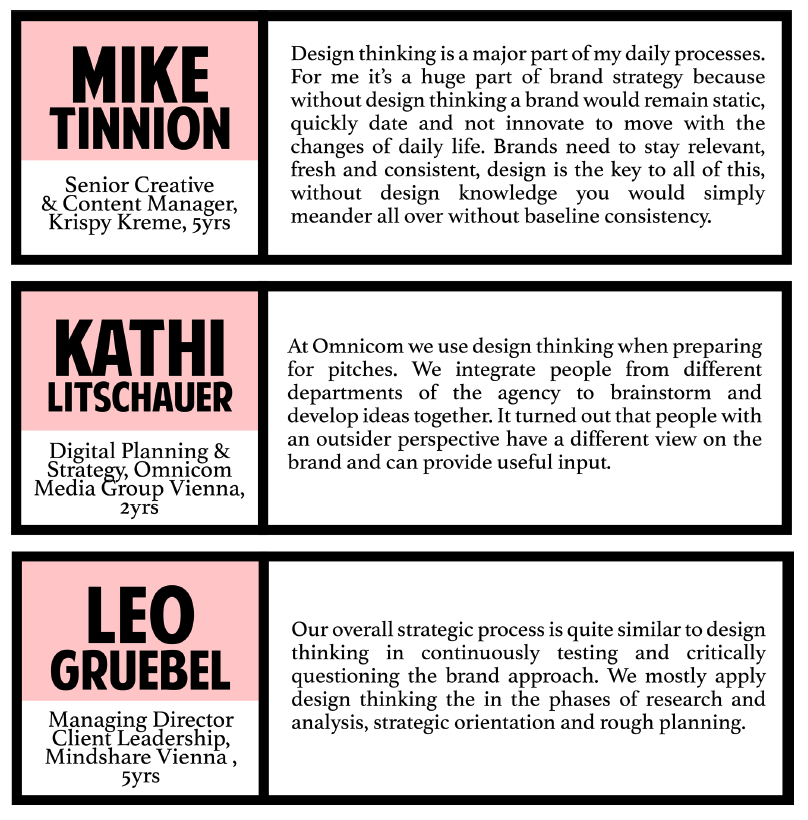
Leo Gruebel explains the importance of brand strategy at Mindshare as constantly challenging and analyzing the business and its market, which then results in marketing and media targets. Analyzing the target group including consumer and media behavior also plays an important role for deriving brand strategy. In addition new brand potentials are researched and compared within the analysis of competitors, industry and current trends. Based on all this information and input, the brand media strategy is created.
For Phil Duncan, Vice President and Global Design Officer, Procter & Gamble, brand management is the “intersection of creativity, strategic thinking, analytical thinking and design thinking. Leveraging both sides of the brain in terms of creativity and business.” (Duncan, 2013, p.46f)
Brand strategy is a versatile and dynamic discipline. Chris Luebkeman, Director for Global and Foresight and Innovation at Arup Group London, believes that the market needs generalists and specialists, nevertheless he sees a concerning trend in the over-supply in marketing generalists. (Luebkeman, 2015)
Gruebel on the other hand currently observes the opposite: after communication strategies being separated in classic and digital until about 2014, it then evolving to 360° communication to create integrated strategies, he now sees a trend towards specialisation, which may be separated in performance (programmatic buying, analytics, commerce) and content (content marketing & social media). This development is driven and influenced mainly by technology, which then again influences and drives consumer behavior.
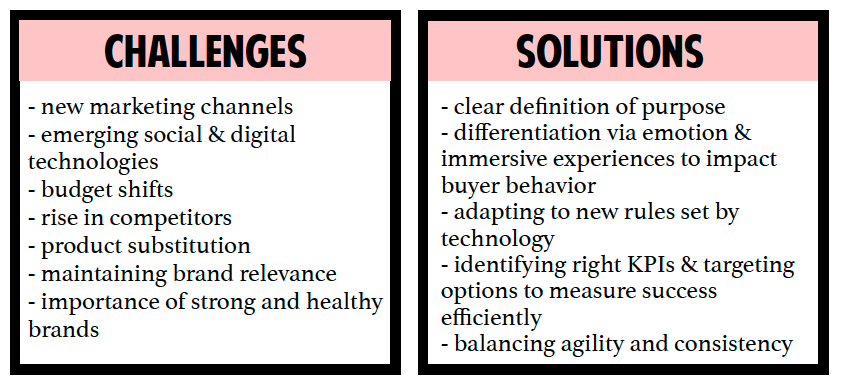
“Digital connects” is the fundamental mantra of Brian Gillespie, Principal & Digital at Continuum. He sees the power of digital in its role as an integrator and connector of experience while successful coordination is the result of teamwork. (Gillespie, 2015)
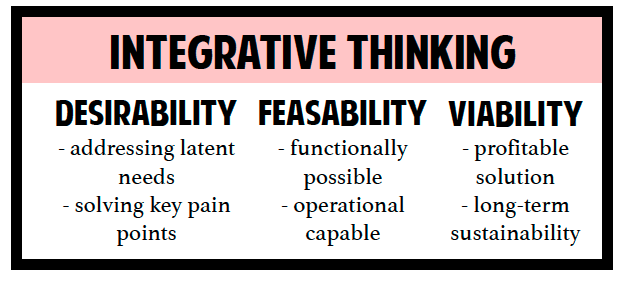
“Design thinking is the capacity, ultimately, for integrative thinking.“ - Tim Brown
Integrative thinkers show an open-minded approach, spot multidirectional relations and patterns in complex data and are able to form ideas by putting together fragmented parts. Integrative thinking consists of three overlapping criteria, brought into harmonious balance, navigated and shifted in creative way. (Brown, 2009)
Aidair, however, draws the conclusion, that “creative thinking, paradoxically, is for 99 hours out of every 100 not very creative, it is endlessly varied combinations of analyzing, synthesizing, imagining and valuing” (Aidair, 2009, p.78)
In addition to that, Neuroscientist Robert Stickgold sees creativity as taking existing information and putting it together in a new and exciting way. (Dreams, 2019)
Mike Tinnion on the other hand emphasizes the importance of design knowledge when working with brand strategy as it gives a deeper understanding on consumer behaviour.
Design thinking is matching human needs, technical resources and constraints of business. However, it is a system with overlapping spaces rather than a step-by-step easy-to-follow process, which I find interesting. I can imagine that to be quite difficult to go back and forth but according to Brown (2009) the nonlinear, exploratory process should be seen as an upgrade, reformation or disruptive and paradigm changing solution instead of a setback.
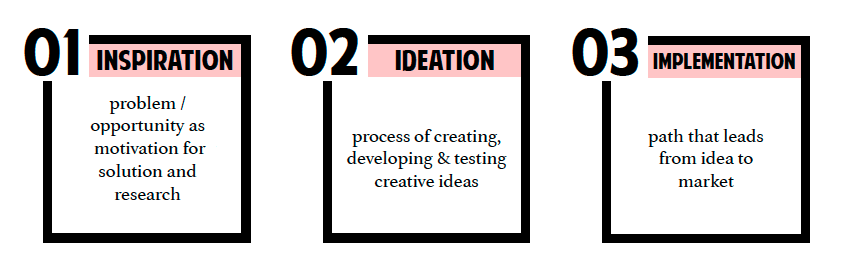
I discovered that the process of design thinking can be explained with three levels although taken into account, that it should loop as new ideas and explorations take place. (Brown, 2009; Issao, 2015)
I found that design is already an important factor in the digital branding process, however, due to more customer touchpoints its significance will increase further. Design will be used across all digital branding to enhance experience, innovation, usability and brand loyalty.
Furthermore the importance of digital brand strategy is growing. It should be a part of every brand strategy, varying in extent, depending on the business and its goals. The value for companies within digital lies in the rapid route directly to the customer, possibility of instant feedback, alternative sales channels and the growing advancements in technology. All of that should be taken into account while staying true to the overarching brand strategy.
In my opinion Kathi Litschauer perfectly summed up the future outlook of digital in context with terrestrial: to reach a broad audience TV & OOH will remain important but for driving specified target groups and sales, digital will evolve to be the main player. Brands need to be digitally visible or they will not survive in the longerm.
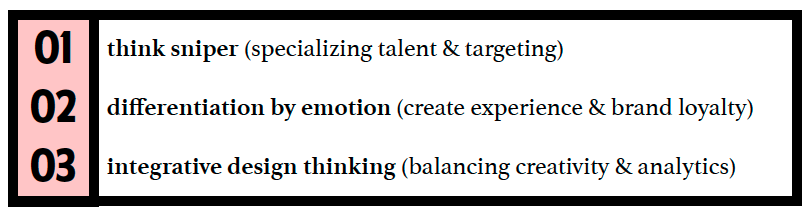
To summarize, three key points for future digital brand strategy and brand strategists can be made:
This report was an individual university project of my Master's course "Digital Design & Branding" at Brunel University London.
REFERENCES:
ADAIR, John (2009): The Art of Creative Thinking: how to be innovative and develop great ideas, London: Kogan Page.
BEST, Kathryn (2015): Design Management: Managing Design Strategy, Process and Implementation, London: Bloomsbury.
BROWN, Tim (2009): Change by design: how design thinking transforms organizations and inspires innovation, New York: HarperCollins.
“DREAMS” THE MIND explained, Season 1, episode 2, Netflix+Vox, 08.12.2019, Netflix, https://www.netflix.com/watch/81062189.
DUNCAN, Phil, Interview by Millman Debbie (2013): BRAND THINKING and Other Noble Pursuits, New York: Allworth Press.
GILLESPIE, Brian, Interview by Millman Debbie (2013): BRAND THINKING and Other Noble Pursuits, New York: Allworth Press.
ISSAO, Fabio, Interview by Millman Debbie (2013): BRAND THINKING and Other Noble Pursuits, New York: Allworth Press.
MOGGRIDGE Bill, Interview by Millman Debbie (2013): BRAND THINKING and Other Noble Pursuits, New York: Allworth Press.